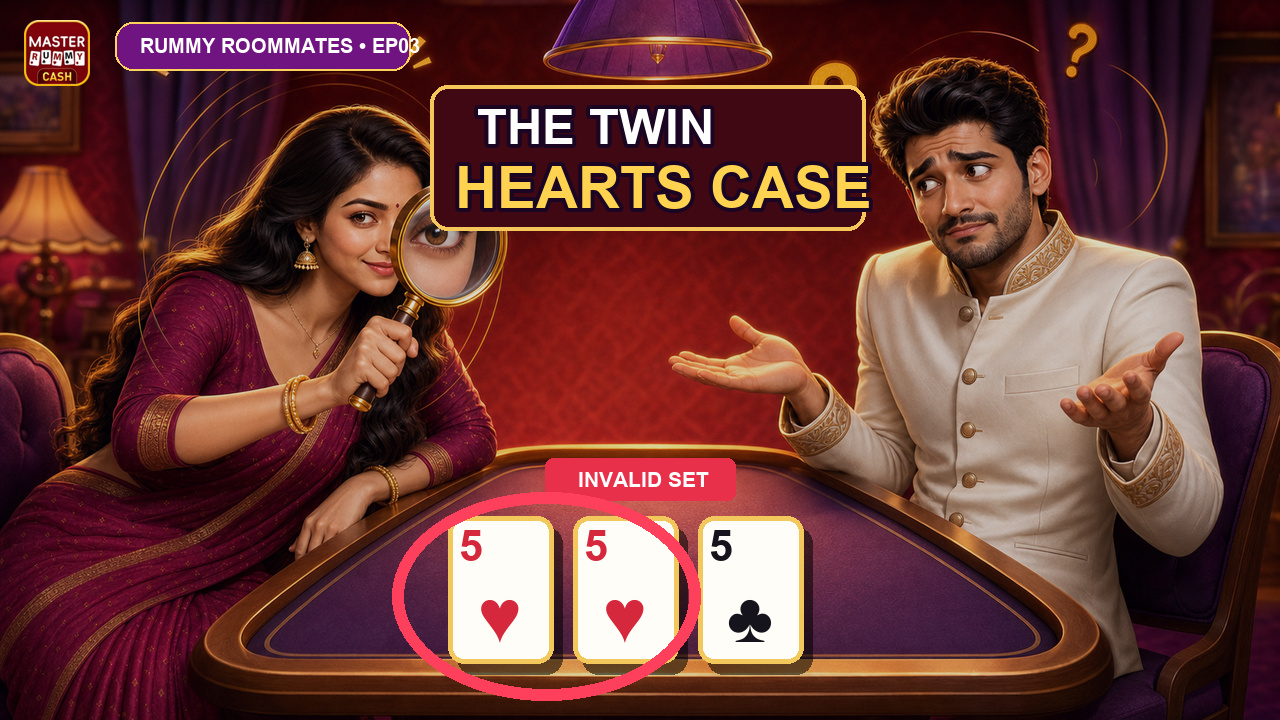
A declaration needs more than a hand that looks almost complete. Check three things: a pure sequence, complete groups, and no card used twice. Use this checklist to avoid an invalid declaration.
An invalid declaration often comes from a missed check, not a poor hand. Make these four steps a habit: inspect, recalculate, check for duplicate use, then declare.
Four Checks Before Declaring
Do you have a pure sequence made entirely of natural cards?
Do you have a second group, either a sequence or a set?
Can all remaining cards be assigned to groups?
Is each card used in only one group?
Example
OK: 4♣-5♣-6♣; 9♠-9♥-9♦; Q♠-Q♦-Q♥; J♦-Q♦-K♦; A♣ (manage this high-value card)
NO: The same Q is used in two different groups.
Visual Comparison
Declaration Decision Table
Risk
Result
How to Fix It
No pure sequence
Invalid declaration
Return to prioritizing a pure sequence
A card is used twice
Conflicting groups
Assign each card to one group, rearrange, and check again
Can I rearrange my cards repeatedly before declaring?
Yes, but run through the full checklist after every change. Do not check only the group you changed.
What are the most common causes of an invalid declaration?
Using a card in more than one group and replacing a card in a pure sequence with a Joker. Start by checking that each card belongs to just one group to reduce mistakes immediately.